Jobs, skills, lower bills - the Territory has a choice.
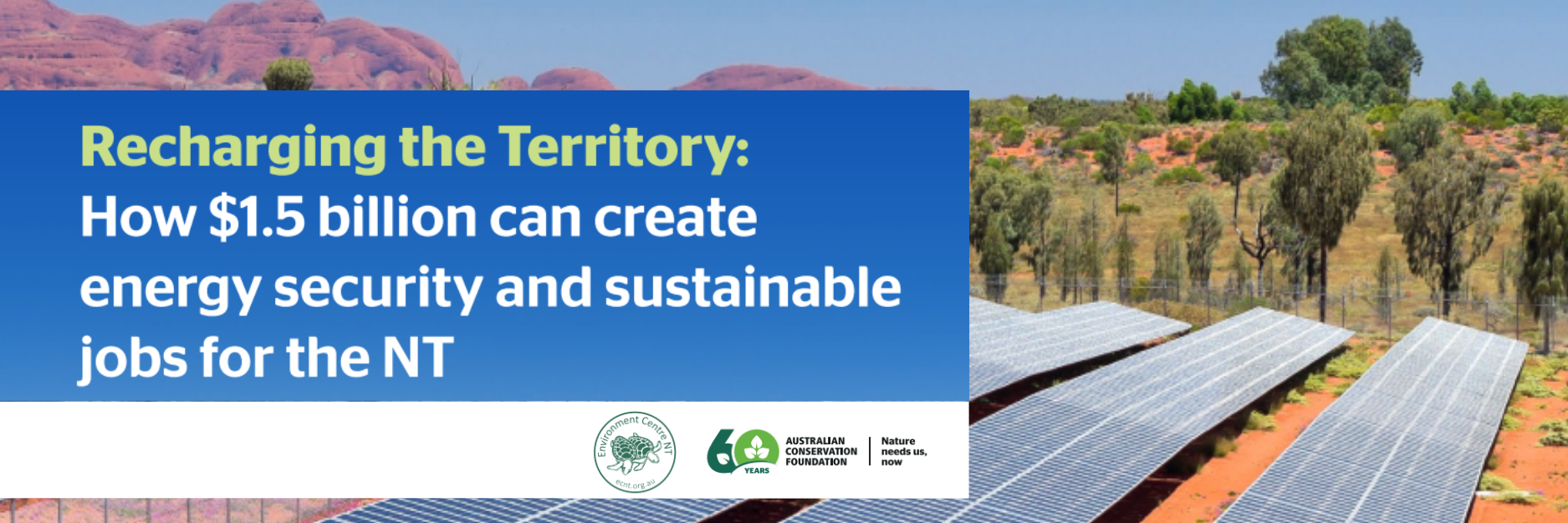
Recharging the Territory proposes an alternative economic vision for the NT that tackles the cost-of-living crisis, while creating energy security and thousands of sustainable, future-ready jobs. This could transform the lives of so many people in the Northern Territory. Recharging the Territory will kick off the renewables revolution and allow us to make large scale solar a reality. This package lowers power bills and gives breathing space for families who are doing it tough. Recharging the Territory gets workers ready for the renewable energy industry and creates thousands of sustainable, local jobs.
In 2025, ECNT together with the Australian Conservation Foundation updated our 2024 Recharging the Territory report, to reflect economic and political shifts.
Click here to read the 2025 Recharging the Territory report.
We have a choice. It’s time for the NT to join the renewables revolution.
The report sets out a landmark opportunity for Federal investment in sustainable industries in the Northern Territory despite the Finocchiaro government’s decision to scrap the Territory’s renewable energy and 2030 emissions reduction targets earlier this year, and builds on the bipartisan commitment to renationalise the Port of Darwin.
The Federal Government’s $1.5 billion dollar program to convert the Middle Arm peninsula into a major gas and petrochemical export hub will transfer public money into the hands of offshore gas companies with little benefit for Territorians, or for a competitive, clean economy future.
Funding this development will come at a significant cost to residents. It will impact our iconic harbour by dredging, building five product jetties, increasing shipping traffic and contaminating our marine environments. It will also impact our health by increasing air pollution, which NT doctors say will increase the cancer risk in children in Darwin and Palmerston. It will destroy any chance we have of securing a safe climate for future generations as it unlocks major gas projects across the Territory, dramatically increasing Australia’s national emissions. Finally, it does not stack up economically, with the Institute for Energy Economics and Financial Analytics finding that the business model is flawed and relies on unproven assumptions. The cost of this will fall on Australian taxpayers.
There is a better way.
Thie Recharging the Territory report shows that redeploying the Federal Government’s $1.5 billion dollar commitment into a Recharging the Territory Package would deliver more high-quality jobs for locals, directly tackle the NT’s cost-of-living crisis and provide the foundations for a strong and diverse new industry sector. We can invest in energy and skills to fix the NT’s unstable electricity system and provide energy security for households. We can deliver energy upgrades for every low income and public housing dwelling in the NT, which will give families economic relief in a cost-of-living crisis. Finally, we can expedite strategic industrial land development at East Arm or return the Port of Darwin to public ownership.
In the NT, we have a choice to transform the lives of Territorians; it’s time to recharge the Territory.

The report proposes the Albanese Government redirect its $1.5 billion commitment to the beleaguered Middle Arm gas hub to:
- Renationalise the Port of Darwin: Invest $490 million to renationalise the Port of Darwin to restore public ownership of this key northern asset and deliver genuine, sustainable industrial growth at East Arm.
- Build a big battery and solar farm to hit 50% renewables and beyond by 2030: Invest $254 million to construct 150 MW/600 MWh of new big battery capacity in the Darwin-Katherine Interconnected System.
- Invest in skills and households: Train Territorians at four new renewable energy campuses at a cost of $25 million. Invest $225 million into a Climate Smart Housing Upgrade program for every low-income household in the NT. Invest $119 million to install solar, insulation and a modern air conditioning system in every single public housing dwelling in the NT.
